Piazza Armerina:
Most Holy Mary of the Victories
(Maria Santissima delle Vittorie)
Patronness of the city and diocese
Patroness of the city and diocese. Province Enna
in central Sicily, in the cathedral (Duomo), 160 x 77 cm, painting on
raw silk, 11th century or older, left: after restoration, right: before
restoration under template.
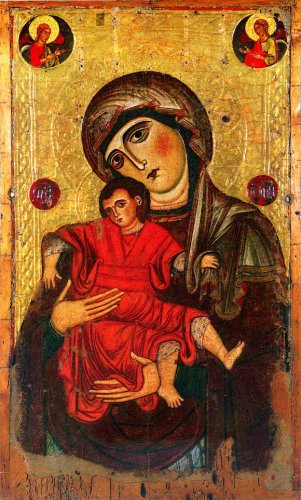
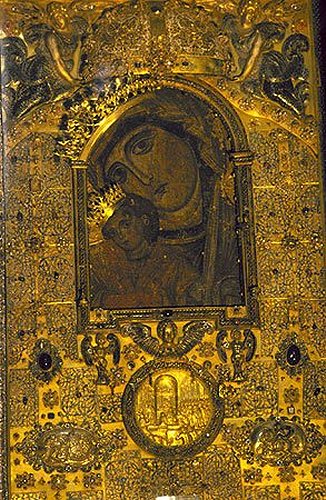
Local tradition, as recounted by the historian Armerino Charanda, attributes this icon to the hand of St. Luke the Evangelist. What was probably meant was that she is an ancient Madonna of the type called Virgin Kykkotissa and the original such Mother with Child was believed to be the work of St. Luke. (For more information see Prague, Breznice)
The story of the Black Madonna of Piazza Armerina goes back to the 11th century, when the military power of the Saracen rulers of Sicily was broken by the Normans. (Civilian Saracens remained a powerful influence in Sicilian society and government for another century.) This mix of Arab and Berber Muslims occupied half of Spain from 710-1492, Portugal from 711 to well into the 12th century, Southern France for more than a hundred years, also beginning in the 8th century, Sicily from the 8th - 11th and Southern Italy from the 8th - 14th century. Their fate in Sicily was sealed in 1059, when Pope Nicolas II made a deal with the Norman conquistador Robert Guiscard (c 1015-85): If the recently converted “barbarians” could bring Sicily back under Christian control, the Pontiff would make him the Duke of the Italian regions Puglia and Calabria. The Normans did break the military power of the Saracens in Sicily, but it took more than three decades and the substantial help of Robert’s brother Roger (1031 – June 22, 1101).
In 1063, when Roger had won a few important battles, the Pope gave him
the banner to take into battle, invoking Heaven’s help against the
Muslims. Under this banner Roger continued to fight until the Saracen
military power was broken around 1091. The Muslims put up a fierce fight
in Piazza Armerina, which was then called Plutia. It was a decisive battle,
which the Christians won in large part because the local population gathered
under the banner of Mary and helped overthrow their former rulers. Roger
remembered this when he had become Count Roger I of Sicily and in gratitude
he gave the precious banner to the city.
There she watched over her happy children while three fairly enlightened
kings ruled in Palermo. But in 1154 King William the Bad, grandson of
Count Roger I, ascended the throne and Sicily fell into chaos and despair.
In 1161, following an attempted coup, some rebels took refuge in Plutia.
In retribution for granting them hospitality the king had the city completely
destroyed. Luckily someone managed to hide the people’s dearest
treasure, the victory banner of the Madonna, from both the guerillas as
well as the King’s forces, who would have brought it to Palermo.
She was concealed underground in a place known by so few that the knowledge
of her secret whereabouts was lost to the dispersed people of Plutia.
After a while the bad king gave the innocent town folks permission to
gather the stones of their former home and build a fortress further up
the hill (today’s district Monte). But no joy could be found in
this strange place that was lacking its Mother. For 187 long years the
people moaned and prayed for relief from oppression and plague.
In 1348 the Queen of Heaven finally answered the pleas. She appeared
in a dream to a pious priest called Giovanni Candilio, who lived in a
nearby village. The Madonna revealed to him the place where the sacred
banner of Victories was buried. She also promised that once her sacred
image was installed in its rightful place, the city would be liberated
from the virulent plague that afflicted the whole of Sicily at the time.
The priest told the people of Piazza Armerina of his dream-apparition,
but no one believed him. So he went to the Bishop of Catania. Luckily
he did believe and ordered that all citizens of Piazza Armerina, after
three days of fasting, would gather as penitents at the place indicated
by the priest.
They did as they were told and on the dawn of May 3, 1348, after some
digging, they uncovered a cypress box with a lighted lamp next to it.
Opening the box, the incredulous onlookers beheld their sweet Mother in
perfect condition. With her was a relic said to be a hair of the Virgin
Mary that is still kept in a silver box in the cathedral. Almost two centuries
of darkness and humidity had not corrupted the banner at all. With great
joy the sacred image and hair was brought to the city and placed in the
church of San Martino, then the main church. Soon the plague ceased and
countless other miracles were attributed to her intercession. With that
her fame spread throughout the Island and beyond.
 |
The Festivals
|
|
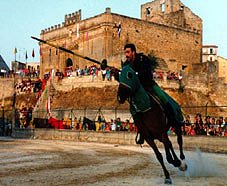
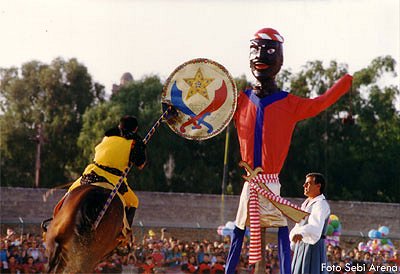
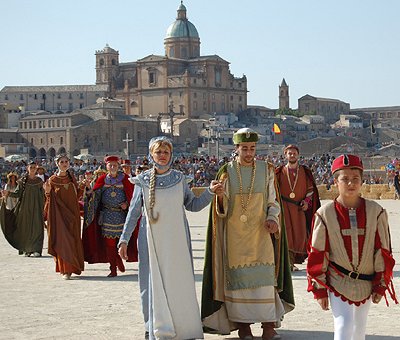
The people of Piazza Armerina celebrate two festivals in honor of their Most Holy Mother. One is held August 12th – 14th, leading up to the Marian feast of the ascension on August 15th. It is called Palio dei Normanni (tournament of the Normans) and is one of the most suggestive “living history” events in Italy, a tournament that has been celebrated since the Middle Ages. It re-enacts the visit of Count Roger I to Piazza Armerina when he came to donate the “Vessel of Victory”, the banner of Our Lady. The first day of festivities takes place in the cathedral. The head of the city lights a candle bearing the image of the Virgin and the “knights” are blessed by the bishop as if they were going into a “holy war”. On the second day costume parades coming from the four old districts of the city meet in front of the cathedral, and Count Roger holds his triumphal entry with his troops. The Count receives the keys of the city and then the parade continues through the streets. On the third day the tournament takes place. The four districts of the city compete against each other and the winners receive a representation of the Banner of Victory, which will hang in their parish church throughout the year.
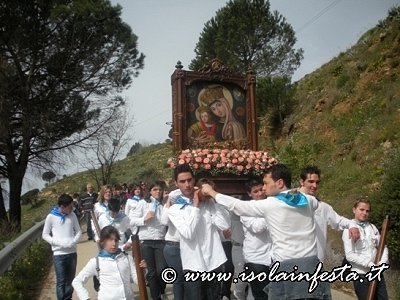
The second festival in honor of the divine Mother is a typical
Sicilian Marian affair that also goes on for several days, from
the last Saturday in April to May 3rd, the anniversary of the recovery
of the sacred banner. It centers on a 19th century copy of Saint
Mary of the Victories in the Sanctuary of Piazza Vecchia, which
marks the place where the sacred banner was uncovered. A tip for visitors: For accomodations I highly recommend a country estate across the valley overlooking the town. Torre di Renda is just minutes away, very comfortable, and serves the most delicious food with love. |
 |