Positano:
The Black Madonna
(La Madonna Nera)
Positano is a village on the Amalfi Coast, in the Campania
region of South-Western Italy. In the church of Santa Maria Assunta, 12th
century, life size.
photos: the Black Madonna before and after recent renovations
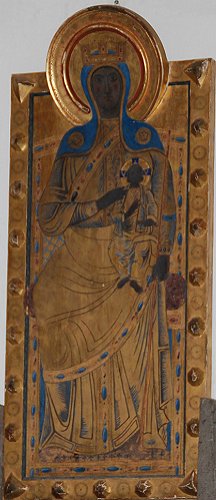
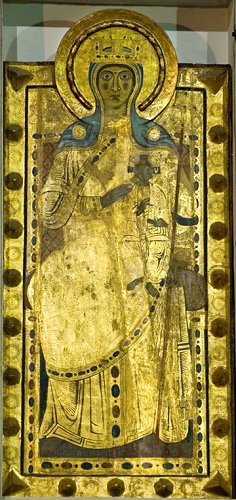
| Many Black Madonnas reside in places formerly dedicated
to a pre-Christian goddess, but this one is different. She was preceded
by female demons: in Homer’s Odyssey Positano is the place where
the sirens try to lead Ulysses astray and into death.(*1)
In the Christian era the roles are reversed: the good female leads
the evil male to the right place. According to local legend, around the year 1000 A.D. the icon had been stolen from Byzantium and was being transported by Saracen pirates across the Mediterranean when a terrible storm came up. Suddenly the frightened sailors heard a voice on board commanding "Posa, posa!" ("Put down! Put down!"). The precious icon was unloaded and carried to the nearest fishing village. With that the storm abated and it was clear to all that it was the Madonna’s will to remain here. Ever since then the village was called Positano in remembrance of the Virgin’s command. |
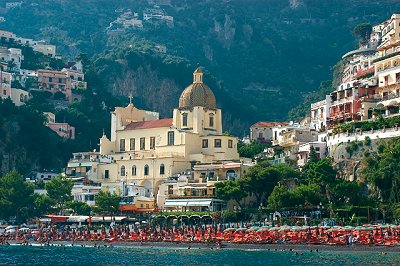 Santa Maria Assunta, the church of the Black Madonna |
| Other websites tell the story differently, but this
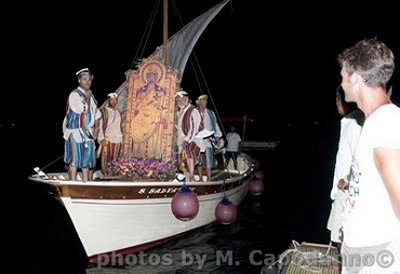
version is the one that is acted out during her feast days.The festivities
begin a week before August 15th, the feast of the Assumption of Mary
into Heaven, and last for another week after. The high point is a
procession of the sacred image by boat on the sea and on land. Ships from Positano have sailed the seas for hundreds of years, trading with distant lands like Turkey and Cuba. They would often be gone for a year at a time, but the crews always tried to be back home in time to celebrate their Madonna for the two weeks of her festival.(*2) At least since the 17th century homecoming crews would follow a certain tradition: upon disembarking they would kiss their native soil, go greet their families, and later they would gather on the main beach in the Grotto of Enchantment (grotta dell’incanto). There they would do some math: each man got his share and the Black Madonna received 25% because all happy endings were attributed to her intercession. The church is full of ex voti thanking her for her help. Not much can be historically ascertained about this Black Madonna, except that she is a Byzantine icon in whose honor a church was built in the year 1200. In the apse of the present church there are still 13th century remnants of a mosaic floor from the original structure. According to one website the Madonna Nera was brought to Positano by Benedictine monks, but I doubt there is any proof for this assertion. (*3) |
|
______________________________________________
*1: “Positano Myth Festival”: http://www.italytravellers.com
*2: “PositanoNews”,
01/08/2010
*3: Comune
di Positano Arte e Cultura