Randazzo:
Madonna del Pileri
(Madonna of the Pillar)
Sicily, in the Basilica di Santa Maria di Randazzo, on the North portico of the church, i.e. facing the altar on the left wall above a gate. 10-13th century Byzantine fresco?
photo: Ella Rozett
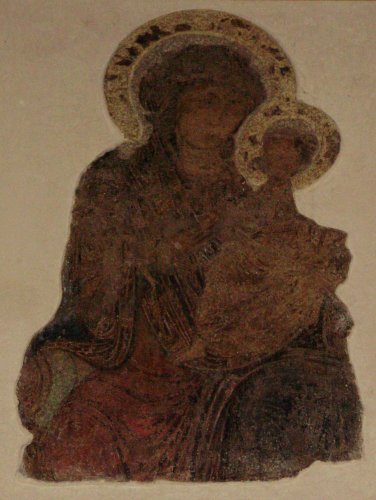
| Although this Madonna is listed as a Black Madonna in
several indexes the local Sicilian parishioners don’t see her
as black, if they see her at all. Even some active members of the
parish have never heard of the Madonna del Pileri in their church.
So she doesn’t enjoy what Ean Begg would call a “living
cult”. But at least the old parish priest who served in 2010
could tell me her story and gave me a book on her, published by his
parish. I am listing her here because of her art-historical value
and because her legend follows the typical pattern of Black Madonnas.
The book “La Basilica Santa Maria di Randazzo: 450. dalla
Dedicazione” tells the legend of the Madonna of the Pillar
thus: In the first century A.D. the apostle Peter sent St. Pellegrino
to evangelize Sicily and he founded the first Christian community
in the valley of Randazzo, before there was even a town by that
name. When the cruelty of the first Roman persecutions reached Sicily,
the Christians of this valley hid in a lava cave of Mount Etna.
Here they lived and worshipped, praying before a fresco of the Madonna
and Child that they had painted onto a pillar. After a while their
hideout was no longer safe and they decided to abandon it. Not wanting
anybody to profane their sacred space, they decided to wall it off
and hide the entrance. With heavy hearts they bid their sacred image
farewell, leaving a lamp burning before it that represented their
love and faith. |
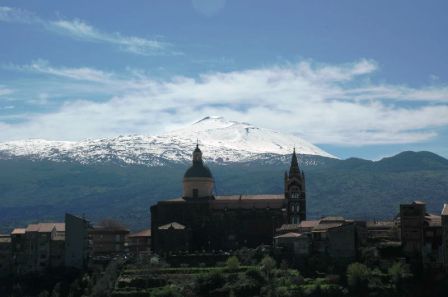 Santa Maria di Randazzo at the foot of Mt.Etna |
With persisting persecutions and passing years, following generations forgot about the sanctuary. About a hundred years later a shepherd pasturing his sheep noticed a constant light shining through a fissure of lava rock. Pressing his eye against the rock, he discovered with amazement what the early Christians had left behind. The perpetual light before the Heavenly Mother and Child was still burning! The people, delighted that the protectrice of their land was found again, built her first a tiny chapel, then a small wooden church and finally the current 16th century basilica, all in the exact spot where the cave sanctuary had been.
The book continues to venture that since the fresco is clearly of Byzantine style, since no other evidence of 1st to 3rd century Christians are found in this valley, and since some of the Arabic invaders were very cruel, it is likely that this story took place during the Muslim occupations of the 8th to 11th centuries. (For more information on Sicilian history concerning Black Madonnas see Piazza Armerina.) All the authors in the book acknowledge that though we don’t know from which century this Madonna really stems, she is certainly “extremely old” and the cult of the Virgin in this area goes way back. Its beginnings are “lost in the darkness of the centuries”, “in an indefinite and mysterious time”.(*) And where there was a cult there was an image, whether this one or another.
It seems that by the 16th century the people were ready for a more modern Madonna to replace the fading fresco. In the new basilica the Madonna del Pilari was moved to the side and the church was dedicated to the Madonna of the Assumption. Now that’s who is celebrated on August 15th, the feast day of the assumption of the Blessed Virgin Mary into heaven, with all the usual pomp and party of Sicilian festivals.
There is no doubt that the people of Randazzo love their divine Mother under whatever title and image she may appear. They still tell the story of an apparition of Mary in remote times to an old hermit who lived in a cave near Randazzo. She promised him that the town would never be destroyed by lava. When Mt. Etna erupted violently in 1981 and a river of magma flowed towards the town the people reminded Heaven of this promise and the course of the river changed at the very last minute. Similarly a 16th century painting in the church tells the story of Mary saving the town from another eruption of Mt. Etna.
Other remarkable elements in the church: black monolithic pillars made of one single piece of lava rock and paintings by the 18th century Sicilian master Giuseppe Velasques.
Tip for visitors: Stay at the family owned
and run Parco Statella.com
a beautiful country estate right on the highway outside of town. It may
be 5 stars during high season, but when I stayed there in October, prices
and demeanor were that of a 3 star hotel.
* La Basilica Santa Maria di Randazzo: 450. dalla Dedicazione, Edizioni Basilica Santa Maria – Randazzo: 2001, pp. 10, 13 and 14.