Rocamadour:
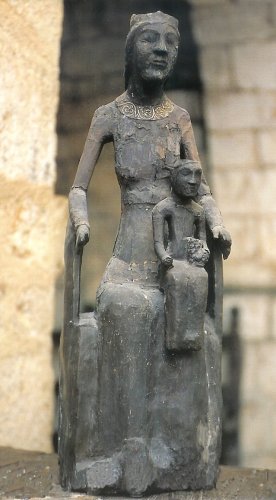
Our Lady of Rocamadour (Notre-Dame
de Rocamadour)
Our Lady of the Poor (Notre-Dame des Pauvres)
In her sanctuary, near Quercy, Lot department, Midi-Pyrénées, 9th - 12th century (?) though attributed to St. Luke, wood used to be covered in blackened silver of which some strips are still in place, 66 cm.
As a Christian holy site Rocamadour dates back to the
10th century, but as a young priest giving a tour pointed out in 2008:
"People have been praying here for 20,000 years." Indeed just
up the hill in the next village over, one can visit a cave with traces
of neolithic sacred paintings.
In the Middle Ages the sanctuary of the Black Madonna became an important
point on the pilgrimage route to Santiago de Compostella. Many saints,
kings, and queens have come here seeking the blessings of the Queen of
Heaven, most notably St. Bernard of Clairveaux.
This spectacular site is set in the rocky side of a steep river gorge.
In 1166, the remains of a certain Blessed Amadour were found here, buried
next to a cave oratory dedicated to Mary. Hence the name Roc-Amadour.
One legend says the man was the servant of the Blessed Mother and like
a nanny and tutor to Jesus. They met when the Holy Family was on their
flight to Egypt. Amadour owned a field of grain that miraculously grew
tall enough to hide the fugitives from Herod's henchmen. Before Mary left
this world, she recommended that, upon her assumption, Amadour go to live
as a hermit in France. He did as he was told and took with him this statue,
which Luke the Evangelist had carved. When he arrived in the river gorge
of Rocamadour, he placed the holy image in a cave dedicated to a pre-Christian
trinity of goddesses. Thus he stopped the human sacrifice practiced there
and Christianized the place. But, similar to Le Puy, there is still a
druidic stone under the altar.
Another legend claims this Amadour, besides being all of the above, was
also none other than Zacchaeus, the disciple of Jesus mentioned in the
Bible. This story gives him a wife, Veronica, the woman who, according
to a very common tradition, wiped the face of Jesus during his passion.
During the Wars of Religion the bones of Amadour were literally pulverized
and scattered. Now only his empty tomb remains.
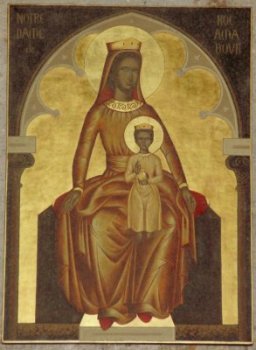
| The Black Madonna of Rocamadour may not be a pretty statue, but it is one of the most powerful, famous, and ancient ones. Our Mother often challenges us not to judge with worldly eyes and not to reject something as not holy because it doesn't satisfy our mundane expectations. Our Lady of the Poor reminds us, "Blessed are the poor in spirit." Once you meet her in person, she seems perfectly elegant and beautiful. Through the eyes of the devotee she looks like the queen in this modern icon, which hangs in the crypt. In the 12th century a collection of 126 reported miracles attributed
to Our Lady of Rocamadour was compiled and many more have been recounted
since. She has healed the sick and insane, punished criminals, threatened
and converted those who did not respect her, won battles for her
followers, brought dead babies back to life at least long enough
to be baptized, freed captives, protected sailors, helped women
conceive and give birth, and performed just about every other imaginable
miracle. |
|
Three pilgrims from Gosa were passing through the lonely
wastelands near Saint-Guilhem, when they were led astray by thieves along
remote and impassable tracks, over steep mountains and along valley floors.
The robbers treated these innocent people injuriously and attempted to
steal the property belonging to these poor of Christ. But the advocate
of all mankind, the powerful Lady of Rocamadour, the exceptional star
who lights up the world with her radiance, came to the aid of her servants
as they called out to her. As was proper, she seized hold of the servants
of iniquity, these workers of wickedness, and took away their sight, which
is a human being's most cherished asset. She also paralyzed their hands
and rendered them immobile like statues, out of pity leaving them only
with the use of their tongues so that they could ask for mercy and express
heartfelt penitence. And so with suppliant cries the robbers fell at the
pilgrims' knees and asked that they placate the Lady, who is gentle but
had been offended by their misdeeds, with their prayers and merits. The
pilgrims were moved by the plight of the afflicted men, and their hearts
were touched. They got down on the ground to pray, raised their voices
to heaven, and asked the Lady of Mercy to take pity on the wretches. Then
the unique Mother of Compassion, the people's hope for the forsaken who
broke the necks of the dragon, the restorer of health, restored the thieves'
senses and returned their bodies to their former health.(*1)
| A special feature of Rocamadour is this unusual bell on the ceiling of the Black Madonna's chapel. People say it rings at the moment when Our Lady saves someone whose life was threatened, especially when that someone is a sailor. Many stories recount how men at sea had implored the Black Madonna of Rocamadour to save them from a storm. They promised to undertake a pilgrimage to her sanctuary if she'd spare their lives. Months later, when they arrived to fulfill their promise and told their story, the priests would say something like, 'Oh, so it was you for whom the bell tolled, letting us know that someone in distress at sea was being saved! We were expecting your arrival.' A stone plaque on the wall lists fifteen years between 1385 and 1617 when the miraculous bell rang without human intervention. | 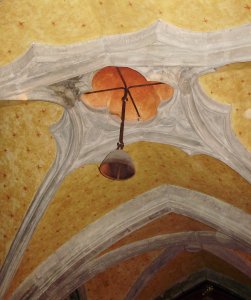 photo: Ella Rozett |
*1: Translated and analyzed by Marcus Bull, The Miracles of Our Lady of Rocamadour, Boydell Press, Woodbridge, UK: 1999, pp. 146-7