Ronzières
Our Lady of Brambles
(Notre Dame de Ronzières)
In her sanctuary above the village, which lays half way between St. Gervazy and Vassivière. 9 km SW of Issoire, Puy-de-Dôme department, Auvergne region, 13th century?, 60 cm, painted wood.
Photo: Mark Veermans
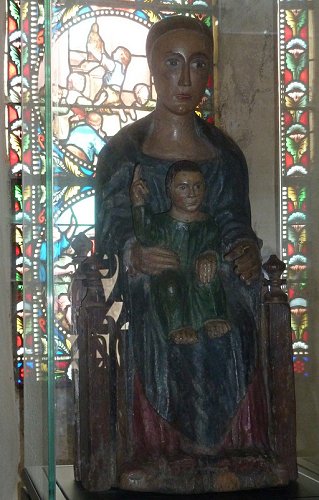
| The hill of her sanctuary lays half way between two of her famous sisters, the Black Madonnas of St. Gervazy and Vassivière. (Driving from St. Gervazy to Vassivière via Ronzières takes about 70 minutes.) Her hill overlooks a great plain and is steeped in ancient history. Early Medieval walls fortify her Romanesque church and enclose an area that comprises remnants of dwellings from the time of the Roman occupation before the Christian era. | 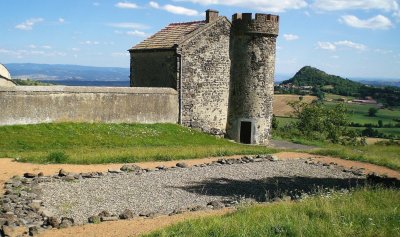 |
|
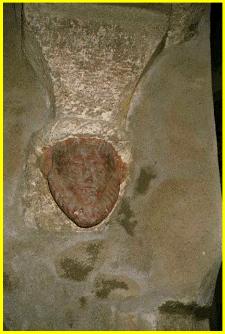
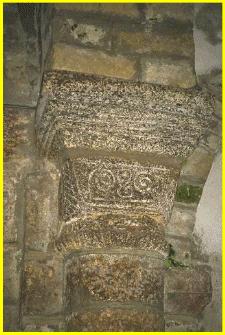
Madam Dulac, on her
magnificent French website on "Sacred Sites" points out
architectural elements of a pre-Christian temple in the church of
the Black Madonna (see fotos on right). What qualifies this lady as a Black Madonna in my mind is her connection
to earth elements, a distant Pagan past, and the reputation of being
a miracle worker. |
|
Legend recounts that Our Lady of Brambles was installed in this place by a saintly priest called Baudimus (Baudime in French). He was a Christian hero who lived around 300 A.D. Pope Fabian sent him with a group of missionaries from Rome to evangelize Gaul (France). He and his brother or very close friend St. Nectarius (Nectaire) ended up in the Auvergne. Their way of "evangelizing" by hostile take over of Pagan holy sites, plunged them into conflict with the local population. St. Nectaire turned a temple of Apollo into a church dedicated to the Virgin Mary. To this day the church sits on Mount Cornadore, a hill top surrounded by a circle of six dolmens and menhirs about one km in diameter. Saint Nectaire ended up getting killed by a Pagan chieftain. Both, Baudimus and Nectarius are buried in the church Saint Nectaire, about 10 km from Ronzières as the crow flies. That church houses another whitened Black Madonna. Baudimus found an ancient spring in Ronzières that was dedicated to the fairies and, much like his brother, dedicated it instead to Mary the Queen of Heaven. He erected a chapel over the spring, placed this statue in it and preached the Gospel there. From then on, say the Christians, the spring ran with healing water. |
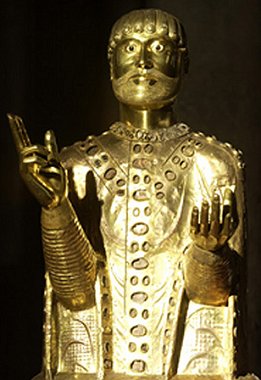 The reliquary bust of St. Baudime |
Apparently the spirits of the earth weren't too thrilled with this take over, for soon the saint had to do battle with a dragon. We know that in Asia dragons are believed to live underground, as the guardians of the earth and its watercourses. But in Europe too there were dragons without wings, called Lind worm, or simply worm. The German word Lindwurm conveys the idea of beautifully glinting gold or silver scales. These represented the "telluric forces", veins of energy running in the earth, called "veins of the dragon".
| In Christian thinking the dragon represents
the forces of evil that, along with the forces of good, suffuse the
world and every human heart. It is the shadow, the dark side. The
time of dragon slayers was a time when humanity still hoped evil could
be vanquished once and for all in a battle with outside forces. The
followers of Jesus at the time of St. Baudime expected that the Kingdom
of Heaven could be established on earth by spreading Christian rule
everywhere. With the centuries, that proved to be not so and dragon
slayers became something of the distant past. People understood that
evil was not something outside of ourselves, but an inner force everybody
had to grapple with. When we learned to recognize and integrate our
own shadows, formerly white Madonnas became honored as black. Eventually
they arose from their thrones and stood on living snakes (the dragons
of old). Sweetly smiling, they hold the living snake in its place
under their naked feet, as if to teach us not to fear nor fight our
shadow, but to make peace with it by mastering and keeping it in its
proper place. But in the 4th century Christians still engaged in outer religious battle against evil, which they saw manifested in Pagan religions and the dark forces of the earth. And so Baudimus' dragon was said to be a hideous monster which lived in a crevice of the cliff of Ronzières and terrorized the local towns. During a fierce battle between the saint and the dragon the monster left its claw marks in a rock that can still be seen on the path near the spring of the fairies. Before it was defeated, the beating of its tail caused the South part of the plateau to cave in. That's what they say. |
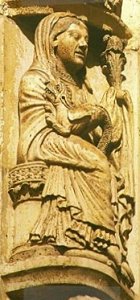 Mary holding a tamed dragon like a lap dog, a very rare type, Chartres relief on the "royal gate". |
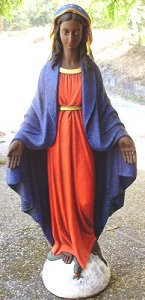 My ordinary garden statue of the type "Our Lady of all Graces" turned Black Madonna by Suli Marr. |
|
After that there was peace, maybe for a hundred years, then "the dragon" reared its ugly head again. This time it was in the form of the "barbaric invasions" into the Roman Empire that lasted from the 3rd to the 5th century. Saint Baudimus's chapel was destroyed during one of these orgies of death and destruction and his Madonna disappeared. Yet the people didn't forget that the place was holy and many centuries later the statue reappeared, now a Black Madonna. According to Ean Begg this happened in the 11th century.* As so often, Heaven used an ox to point out where the precious treasure lay buried in the earth. It is said that an ox got his foot stuck in a whole in a rock. When the cowherd came to his aid, he discovered the Black Madonna under the animals' foot. To this day, girls who are looking for a husband slip their foot into the "step of the ox" and deposit an offering of flowers right there or in the church. |
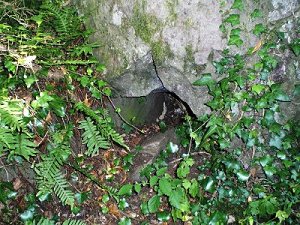 the 'step of the ox' |
| You may find the step of the ox, the foot print of the dragon's claws and the fairies' spring if you follow the little path that leads down the hill behind the church. It is part of the pilgrimage path to Santiago de Compostella. |
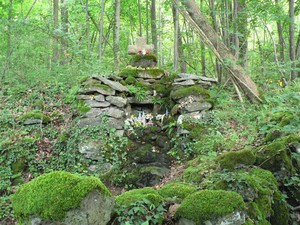 the fairies' spring |
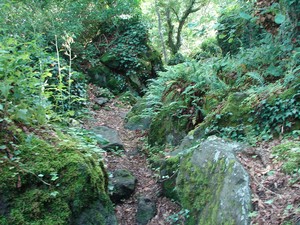 the path to it |
| The place the unmarried maidens seek is not too far down from the church, in the middle of the path. To get to the spring, you have to go all the way down the hill, then turn left off of the path. The claw marks are in the middle of the path, near the spring. It takes a bit of attentive looking and tuning into the spirit of the place to find these land marks. Look for tilted up stones that mark the way and for little green dots that mark the rocks (see top right in picture). Good luck! |
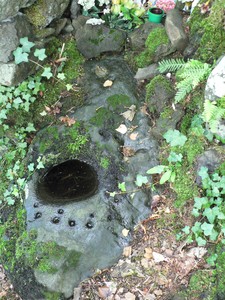 the claw marks of the dragon |
A couple of miracles attributed to the Black Madonna are still fondly
remembered in the parish: In 1911 a little girl was healed against all
expectation during a mass that her grandfather had asked to be celebrated
for her in Ronzières.
In the 19th century the Madonna revealed to a boy that he was called to
be a priest. It didn't make sense at the time because the lad had a handicap
that precluded him from qualifying for the priesthood. In time however,
he was miraculously healed by Don Bosco, a saintly Italian priest. Hence
he could fulfill the Virgin's revelation.
____________________________________________________________
* Ean Begg, The Cult of the Black Virgin, Penguin
Books, London: 1985, p.217.