Saint-Gervazy:
Our Lady of Saint-Gervazy
Sain-Gervazy lies 6 km SW of Saint-Germain-Lembron,
Puy-de-Dôme department, Auvergne region, 2nd half of 12th century, 76cm,
painted wood.
Photo: Francis Debaisieux
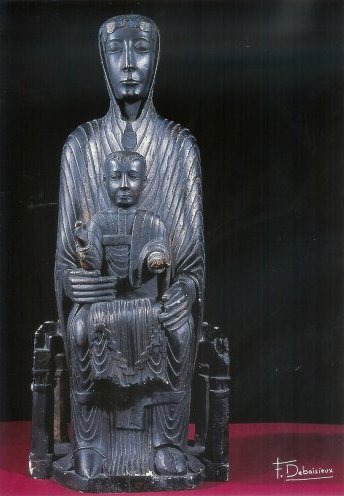
No miracles or other "special effects" are reported about this Virgin. During the Middle Ages she was obtained by the Saint-Gervazy family and brought to their little castle by the same name. Later she was moved into the charming little village church that had been erected in the 10th or 11th century.
This Madonna is revered for her beauty and classic Romanesque style. Like many other Black Madonnas, she was stolen out of her church. But this one was found again 17 years later, in the year 2000. By that time she had changed owners 5 times, so that the people of Saint-Gervazy were forced to buy her back.(*1)
| About ½ mile outside the village you'll find this ancient
stone structure, a dolmen, under an oak tree.(*2)
This may not be a coincidence. Several Black Madonnas are associated
with pre-Christian sacred stones. (e.g. Le Puy, Mauriac, and Saint
Nectaire) They inherited their sacred sites from druidic times. How
did the druids (Celtic priests) use dolmens? We don't really know.
Most people think they were collective Neolithic burial chambers,
built in Europe between the 5th and the 3rd millennium B.C., before
there were druids. One dolmen often sheltered the remains of generations
of people, like our family graves. Some scholars conjecture that dolmens were altars used for sacrifices and other rituals. The word is a Gallic expression from Brittany meaning stone table, which supports the latter use. It is conceivable that the druids used these ancient burial chambers as altars, especially where they hadn't served as tombs in hundreds of years and where they may mark special earth energy fields. There is archeological evidence for both uses.(*3) |
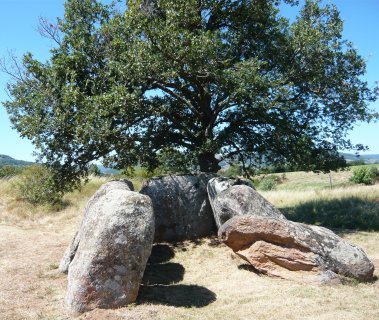 The top slab slid off and lays behind the dolmen. Photo: Marylou Hillberg |
| It is just one of those "coincidences" that after spending some time at the dolmen of Saint-Gervazy and wondering about its use, we stopped at a post office in a nearby village. While waiting in line I noticed a display of little 8 page guides on such varied themes as the Israelites, the Gaul's, the solar system, mushrooms, stress, aroma therapy, mathematics, etc. I picked up "les Gaulois" and found this depiction of a dolmen. It shows Gaul's during their most holy ritual: the harvest of mistletoe from a majestic oak tree. Standing on a dolmen, a druid dressed in white robes uses a golden sickle to cut the mistletoe, considered the sex organ of this most sacred of trees. The juice pressed from its berries was seen as divine sperm, which rejuvenated and healed many ailments.(*4) So that's why we get to kiss whomever we meet under mistletoe during advent - we must express the sex drive of that ancient God! | 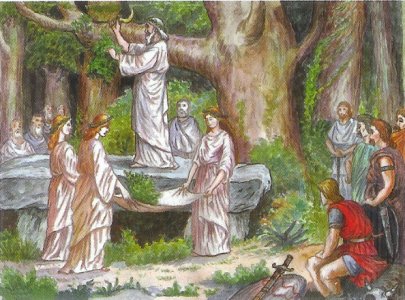 |
*1: See website of the Association Vierge Noire de Saint
Gervazy, www.avnsg.free.fr/home.htm
*2: Leaving the church on your right, head out of the village, bear left
at Y intersection, turn right at the T intersection, then left at the
sign that says 'dolmen'.
*3: see article on 'dolmen' in fr.wikipedia.org
*4: Les Gaulois, Petit Guide, Aedis Editions, Vichy: 2007, p. 7 and Michèle
Bilimoff, "Les plantes, les homes et les dieux", Editions Ouest-France,
Rennes: 2006, p. 26