|
Saint Guiraud: Our Lady the Black One In her chapel in the center of the village, about 40 km and 40 min West of Montpellier and 20 min North of Pézenas (another Black Madonna site), Hérault department, Languedoc-Roussillon region. Any villager will tell you who has the key to let you in, 10th century, 70cm, formerly painted wood. Photos: Ella Rozett |
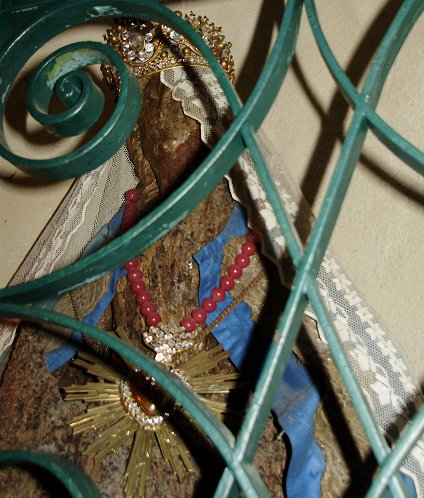 |
| Here you see what happens when you don't renovate wooden statues once in a while. This Black Madonna is so worm eaten that you can barely make out the face and of baby Jesus only a little stump is left. If she wasn't dressed like a queen, you'd take her for a piece of fire wood. And yet this very ancient Madonna emanates a powerful energy and has been reputed as a miracle worker for about a thousand years. The earliest written record of a church in the village dates from 1101. The little old church lady who guards the key to the chapel told me in 2009 that those records already mention a statue being taken on a procession. We assume it was this same Dark Mother. Tradition says that she was brought to France from the Holy Land by a pious crusader around 950 A.D. Scholars think that she may be a 14th century replacement of the original.* By the 15th century her chapel was one of three main pilgrimage
sites in the county and the oldest one of them. Our Lady the Black
One was famous for her miracles " and the affluence of her visiters
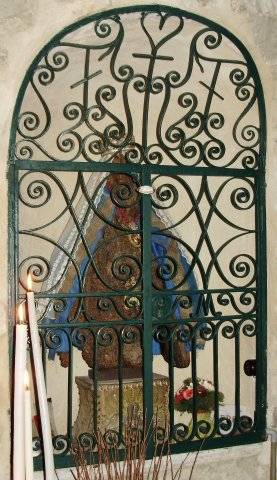
". On May 14th 1855, Pope Pius IX declared Our Lady's sanctuary a "priviledged altar ". At that point she was moved from her original place above the entrance to a place of honor above the altar. Some time later she was relegated to the back of the chapel and placed on "a vulgar pedestal". Her present niche to the left of the altar was built in 1896, supposedly to honor and protect her. Her feast day procession is celebrated on September 8th and the old folks still have miracle stories to tell about their Black Madonna. If you are in the area, don't miss one of France's most beautiful villages, Saint-Guilhem-le-Désert, 15 minutes North-East and the fully preserved Knights Templar town La Couvertoirade 30 minutes to the North. |
|
* A French, Catholic site called "Under the Sign of Saint Michael" (http://s.st.michel.free.fr) published an article on 2/25/08 entitled "Visite de lieux saints à Saint Guiraud et à Saint Saturnin de Lucian " All quotes in this article are taken from there.