Thuir:
The Virgin of the Victory
(La Vierge de la Victoire)
Department Pyrénée-Orientales, region Languedoc-Roussillon,16 km SW of Perpignan, close to the Black Madonnas of Cuxa and Finestret, 50 cm, late 12th century, one of five statues cast in lead from a mold.
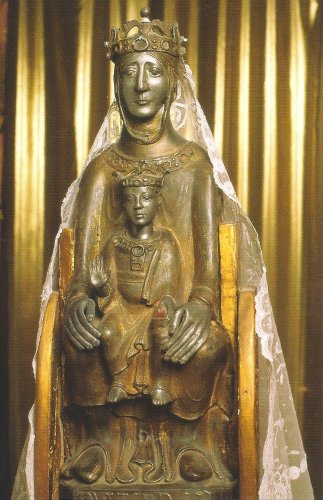
The little old church lady who led me to the church of Our Lady of Victory knew nothing of a Black Madonna at her church. The little statue is hardly visible in her place of honor high above the altar, far from where ordinary people are allowed to go. It didn’t seem to me that she enjoys what Ean Begg calls “a living cult”, although according to him her feast day is celebrated on October 7th when Christian armies won an important victory over Muslim occupiers in 1571. If one believed some of the legends that have been told of her, she would meet many characteristics of a Black Madonna. However, they are contradictory.
Presumably there was an older Black Madonna in her place that was lost
somehow. Some say it was brought from the Near East by a crusader by name
of Sir Montmorin St Héreme.
Another legend connects it to Charlemagne, who lived three centuries before
the first crusade. It explains the title of the Lady as follows: One day,
Charlemagne was in the valley of Thuir, ready to fight the Muslim invaders
of Southern Europe. His troops however, worn down by heat and thirst,
were on the point of surrender to the enemy. So the emperor placed the
Madonna in the midst of his army, invoked her help, and thrust his sword
into the sand of a dry river bed. Immediately a well of abundant water
sprang forth and gave the Christian soldiers new strength. After receiving
miraculous help from Heaven, they had no trouble defeating the enemy.
Having won the victory with the help of the Queen of Heaven, the emperor
decided to found a monastery on the site of the miracle, which became
known as the Monastery of the Camp.
Later the Muslims again invaded those parts of Europe and weren’t
driven out so easily. Since they were prone to destroying “idols”,
the statue was hidden from them. Once their reign had ended, a shepherd
found the Madonna in a dense forest when he had ventured there in search
of a lost animal. A chapel was built in her honor and around it the town
of Thuir began to grow up. For several centuries she enjoyed great fame.
The first mention of Marian devotion in Thuir is from the 13th century
and the first record of this Black Madonna is from 1567. Every year a
priest was elected to ceremoniously change her robes.
Ean Begg mentions that many healing miracles were attributed to this
Lady’s intervention and that she was carried the ca. 25 km to the
sea and dipped in the waters at Canet a couple of times in order to end
a drought. (more on those kinds of Black Madonna rituals at les-saintes-maries-de-la-mer.htm)
The Virgin of Victory was also invoked to help in difficult childbirths.
For that purpose pieces of her robe were touched to women in labor. They
are kept in the church to this day. (for more on “birthing belts”
of Black Madonna go to Toulouse)
The statue survived the Revolution because a certain Mrs. Foussat hid
her.
________________________________________________________
Sources of information: Ean Begg, The Cult of the Black
Virgin, Penguin Books, London: 1985, pp. 226-7 and Lieux
Sacrées