South Africa, Soweto:
The Madonna and Child of
Soweto,
The Black Madonna
In the Regina Mundi Church in Soweto, painted by Laurence (Larry) Scully, in 197, 8 x 5 foot.
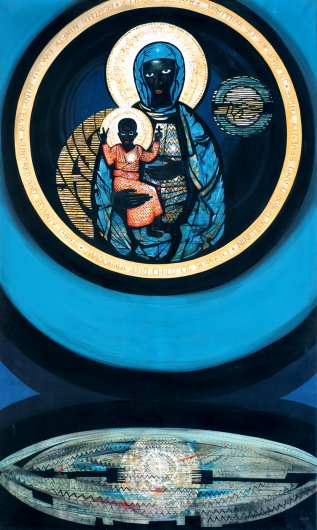
This is not one of those traditional, ancient European Black Madonnas with miraculous powers that begs the question: "Why is she black?" Here it is obvious: she is black because her people are black and because she is making a statement about being with them rather than just their colonizers. One would expect African Madonnas and Jesuses to be black, and yet they often are not. As Immaculée Ilibagiza says: "…even in African Bibles that were written in Kinyarwanda (a language of Rwanda), Jesus was always portrayed as a white man with beautiful blue eyes and long, blond hair. I used to laugh when a group of European volunteers would come to the orphanage, and the children would point to them in awe and say, "Look how many Jesuses have come to see us." *
Even when African Madonnas are black, they are not necessarily called by the title Black Madonna. The fact that this one is, deserves attention. The artist, Larry Scully, named his painting The Madonna and Child of Soweto, but she is known in her town simply as The Black Madonna.
Here are excerpts from an article on Larry Scully, published on the website: www.soweto.co.za
In 1973 The Star newspaper, a liberal, anti-apartheid newspaper in Johannesburg commissioned Scully to paint a picture to raise money for an education fund for black South Africans. Scully painted The Madonna and Child of Soweto, some 8 foot by 5 foot in size. Harry Oppenheimer of Anglo American bought the painting that was then donated to the Regina Mundi Church in Soweto. Regina Mundi was the site of much anti-apartheid activity both in the 1970s and through to the ending of apartheid in the 1990s. Numerous funerals of activists were held in the church and many organizations used the church for meetings. During the student uprising in 1976, (several thousand) students fled to Regina Mundi after police shot at them. (Police stormed the church and opened fire, killing several people. To this day one can see the scars of this brutal act of violence.) In 1997, Nelson Mandela declared Regina Mundi Day in recognition of the importance of the church to the anti-apartheid struggle. As Michael Morris has noted the painting "had a prophetic quality: the focal point is the child's right hand, forming a victory sign."[Morris Interview with Scully in Matieland February 2002}.
In 2004, journalist Mpho Lukoto reflected on 10 years of democracy in
South Africa by saying of the painting:
"Perhaps one of the most poignant reminders of the past is the Black Madonna
and Child of Soweto, which was painted by Laurence Scully. Beneath the
image of the Black Madonna, Scully painted an eye, with the different
images in it giving meaning to the picture. The pupil of the eye represents
the township. The two black forks that run across the eye toward the pupil
represent the pain inflicted on black people. And in the center of the
eye, representing the Church, is a cross with a light that illuminates
the pupil. It struck me that in the midst of all the painful memories,
the painting is a symbol of the hope that, like the church itself, was
in the heart of the people. I like to believe that it was that hope that
makes it possible for us to celebrate 10 years of democracy." The Star,
March 23, 2004
Today thousands of visitors from all over the world still see The Madonna
and Child of Soweto on tours of the City and the image of the black Madonna
is printed on t-shirts that are sold across South Africa.
________________________________________________________________
* Immaculée Ilibagiza with Steve Erwin, "Led by Faith:
Rising from the Ashes of the Rwandan Genocide", Hay House, Carlsbad: 2008,
p.113