Senegal, Popenguine:
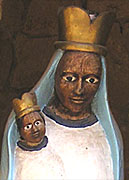
Our Lady of Deliverance
(Notre-Dame de la Délivrance)
17 km North of Mbour, 80 km South East of Dakar, in an ecological sanctuary, 1888.
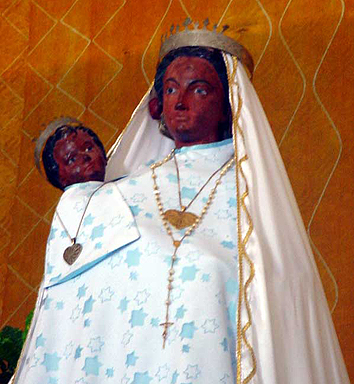
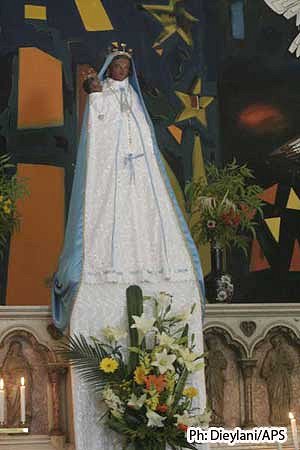
In 1887, Bishop Mathurin Picarda visited the mission
of the Holy Ghost Fathers in Guéréo, Senegal, for
the baptism of its first Catholic converts. The priests took a walk
along the coast to the village of Popenguine. "What a magnificent
site for a sanctuary to the Virgin!" the bishop observed. A
native of Brittany, he decided to designate a famous Black Madonna
from the neighboring province of Normandy, Notre
Dame de la Délivrande, as patron saint of the shrine
he wanted to see built. A Norman benefactor provided a replica statue.
Her title was altered from the Celtic Notre-Dame de la Délivrande
to the French Délivrance and she was installed in Senegal
on May 22, 1888, the Tuesday after Pentecost, with a great procession.
Tens of thousands of pilgrims, many of them organized groups of young people, and many inspired by rumors of Marian apparitions there, go to Popenguine for an annual celebration on Pentecost Monday, the Black Madonna’s feast day. They celebrate a solemn mass and then a procession from the church to a nearby grotto shrine of Our Lady of Deliverance in a cliff overlooking the sea. Various 2008 articles lauded the ongoing Christian-Muslim dialogue in Senegal. Its fruit is peace and it expresses itself in the presence of many Muslim families, who joined in the pilgrimage to Popenguine at the side of their Catholic brethren. |
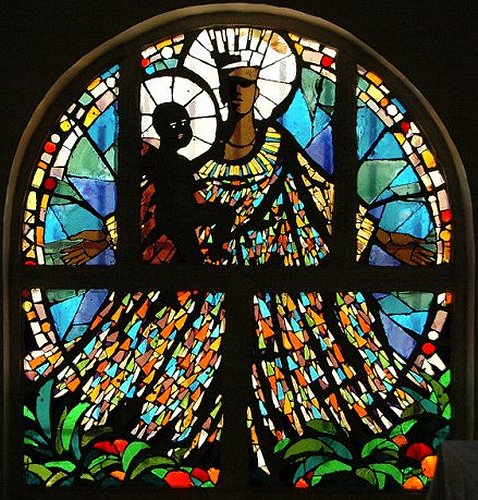
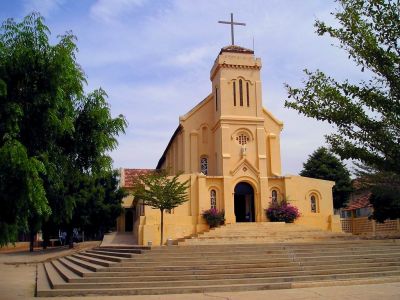
photo above: the statue of Our Lady of Deliverance photo right: the church in Popenguine |
 |
sources: http://www.wherewewalked.info/feasts/05-May/mon_after_pentecost.htm and http://www.senegalaisement.com/senegal/popenguine.php and “Beaucoup de musulmans aux côtés des catholiques” (i.e. “Many Muslims at the Side of Catholics”)