Algeria, Algiers
Our Lady of Africa, or Madame l’Afrique, Our Lady of Algiers
In her 19th century Basilica above the neighborhood Quartier Notre Dame, overlooking the Meditaranean, bronze. Open daily 11-12 a.m. and 3-5:30 p.m.
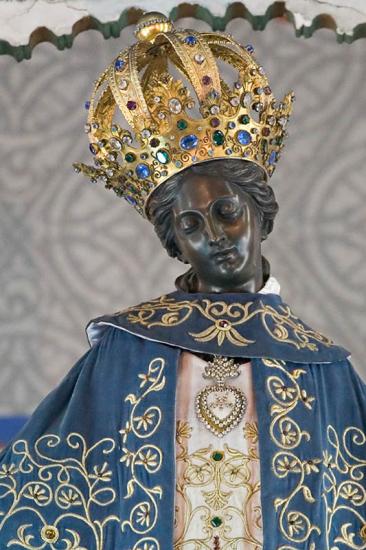
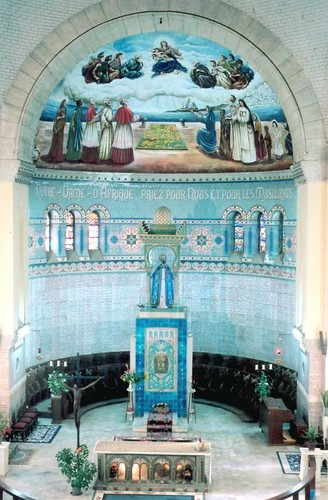
| Madame l’Afrique is a copy of a French statue crafted in silver by the artist Edmé Bouchardon (1698-1762), which was destroyed during the Revolution. This bronze copy was ordered in 1838 by the Archbishop of Paris, Monseigneur de Quélen. Apparently he had asked Our Lady for the conversion of Prince Talleyrand of France, a very controversial diplomat and foreign minister under Napoleon who had strong ties to the church. In order to fulfill his part of the deal, the archbishop had this statue made. Whether the Queen of Heaven granted his request is hard to tell, but many did laud Prince Talleyrand as an excellent diplomat who was often intent on avoiding blood shed. He was by no means a saint though. Soon after the statue had been cast, it was presented to the first bishop of Algeria, Monseigneur Dupuch. The French army had landed in Algeria eight years earlier and was in the process of gradually occupying the whole country. The bishop charged the Black Madonna with the role of bringing peace between Muslims and Christians – the kind of peace that would make the French Christians happy, of course. Hence the mix of her European features and style with her dark complexion and Muslim robe richly embroidered in the “Tlemcen” style, an Algerian province that exports textiles. Supposedly the vestment was crafted by a devout Muslim artist with a deep love for the mother of the great prophet Jesus. (Her crown was a gift of Pope Pius IX.) Her basilica was inaugurated in 1872 and continues the theme of
ethnic and religious reconciliation with a big inscription on the
wall behind her, which reads in French: “Our Lady of Africa,
pray for us and for the Muslims.” |
 |
| The outstretched arms, smiling face, and inclined
head of Our Lady of Africa mark her as the type of Madonna called
“Our Lady of All Graces”. This type goes back to a series
of apparitions of Mary to Sister Catherine Labouré in Paris
in 1830. At that time the Queen of Heaven appeared in this pose,
wearing rings on her fingers that were covered in jewels, most of
them emitting a magnificent light. She said: “This is a symbol
of the graces which I shed on those who ask me. Those jewels which
are in shadow represent the graces which people forget to ask me
for.”* She also demanded that a medal (the so-called Miraculous
Medal) be crafted and widely distributed, depicting herself in this
pose on one side. On the other side she wanted the cross of Jesus
permanently anchored in her initial M and their two hearts underneath
it, perfectly equal in size. |
 |
 |
* Roy Abraham Varghese, God Sent: A History of the Accredited Apparitions of Mary, The Crossroad Publishing Co. New York: 2000, p.95