Windhausen:
The Black Mother of God
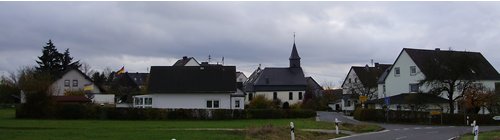
Windhausen is a little village across
the highway from Herschwiesen, a slightly bigger village with a famous
baroque church. Both are part of the city Boppard in the Rhein-Hunsrück
region. The chapel is open all day and lays about 15 minutes from the
home of another Black Madonna in Beilstein on the Mosel, which is even
more worth a visit.
Photos: Ella Rozett
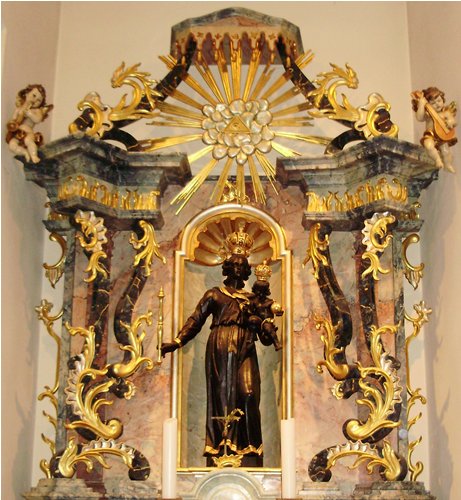
| Tradition says that around the year 1775 a local tenant farmer by name of Peter Becker sought relief from a debilitating illness at the feet of the Black Madonna in the Carthusian monastery near Koblenz. When the Queen of Heaven heard his prayers and did indeed heal him, he erected, in thanksgiving, a small chapel in his home village Windhausen and placed in it a Black Madonna similar to the one he had sought out. Several miracles and wonders took place immediately. E.g. a wilted lily in the hand of the Madonna brought forth fresh buds and during a prayer meeting that Peter Becker held with others the statue lit up with a heavenly light. A boy was healed of paralysis, a blind person was given sight, and a girl could leave her crutch at the feet of the Madonna. With that of course so many pilgrims started coming that a bigger chapel was needed, which Mr. Becker promptly provided. |
 |
|
This honeymoon between the divine Mother and her children didn’t remain
undisturbed for long. The king had ordered enlightenment and religious
equality between Catholics and Protestants. This meant the presence
and power of Catholicism had to be reduced and “old time religion”
with its “superstitions” was frowned upon. As in other
places (see Chartres) Catholic clerics used this as an excuse to
curtail grass roots practices they hadn’t dared to forbid
before. Now the local bishop prohibited the collection of offerings
and the presentation of ex voti in the Windhausen chapel and ordered
the Image of Grace to be moved to the parish church in Herschwiesen.
But since the chapel and the statue were the private property of
Peter Becker, he simply took the Black Madonna into his home. |
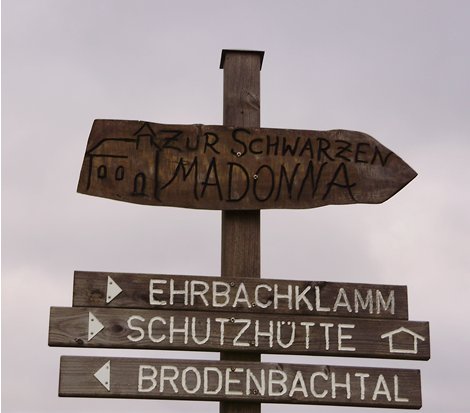 "To the Black Madonna" |
At the end of World War II the chapel was badly damaged, but the Madonna
was saved by some neighbors who ended up housing her for three years.
The necessary repairs seemed almost impossible to accomplish in the postwar
years, but Mother Gipp, the hostess of the Black Madonna, kept urging:
“Finish the chapel and my son will come home from the French prison
camp where he is held! When the chapel is complete the Mother of God will
send him home.”(*1) And so it was. The night
before the rededication ceremonies Mother Gipp’s son called to say
he was in Boppard, almost home. He attended the opening mass the next
day.
The postwar repairs were only rudimentary. It took till 1985 for the shrine
to be restored to its former glory. Since then pilgrims come once more.
The booklet from which I have taken most of this information quotes a
local poet who writes: “…all thoughts and words died in me
when I stood before that dark miracle in glowing, sparkling light, of
which grandfather and the old mothers in the village had told stories…”(*2)
Yes, that indeed is the mystical power of the Black Madonna: to halt our
thoughts and concepts long enough so we can experience the divine spark
in everything.
___________________________________________________________________________________
*1: The Catholic parish of Herschwiesen, “Pilgerbüchlein
zur Schwarzen Muttergottes von Windhausen”, Boppard: 2005, p.12
*2: ibid, p.11