|
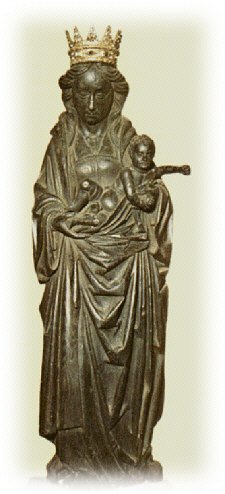
Ireland, Dublin: The Black Madonna, Our Lady of Dublin In the church of the Carmelite order of nuns in Whitefriar Street, probably early 16th century, natural oak wood. |
 |
This statue has had a rough life, but now the Black Madonna enjoys good
health, so to speak, and an enthusiastic following. So, all's well that
ends well.
She may have been carved by a student of the famous Albrecht Dürer for
the Cistercian St. Mary's Church. Popular belief has it that during the
Reformation she was partially burned, rescued, buried, and used as a hog-trough.
It was common practice to hollow the backs of wooden statues, both to
reduce weight and to prevent the wood warping and splitting. Thus laid
face down, the figure could form a shallow trough for pigs. However there
is evidence that she was actually saved form this fate suffered by so
many other statues, and kept in hiding until it was safe to install her
in a church again.
Whatever ordeal she went through must have left some ugly scars, for she was completely white washed after the Reformation. From 1700 to 1816 she was venerated in the Jesuit chapel in St. Mary's Lane. At that point the old chapel was converted into a school. Though a new church was erected nobody seemed to want the whitewashed Mary. It appears that she was discarded. But Heaven wasn't done with her yet, and so she found her way into a second hand shop, where a Carmelite priest by the name of Father John Spratt found and bought her in 1824. He had the statue repaired and donated it to the renewed Carmelite Church built in 1827 on the site of its original 13th century foundation. Here she still resides today.
In 1914 the whitewash was removed and with it also the original polychrome
colour of her robes. The extended arm of the Child is a modern restoration.
In 1915, the shrine of Our Lady of Dublin was formally erected in the
Carmelite church.
Ean Begg states that the fine gold crown of the statue was probably used in the coronation ceremony of Lambert Simnel (fl. 1477 - 1525), a ten year old impostor to the throne of England who threatened the newly established reign of King Henry VII (reigned 1485-1509). At the time, the crown was borrowed from another Mary statue for the purpose of the coronation.
The Pomegranate in Jesus' Hand
Baby Jesus is holding a pomegranate in his right hand,(*1)
an ancient symbol of several goddesses, which was picked up by Judaism
and Christianity.
Wikipedia has a long, interesting article about it under the heading "pomegranate".
Here is a shortened excerpt:
Judaism
Exodus 28:33-34 directed that images of pomegranates be woven onto the
hem of a special robe worn by the High Priest. 1 Kings 7:13-22 describes
pomegranates depicted on the capitals of the two pillars which stood in
front of the temple in Jerusalem. It is said that King Solomon designed
his coronet based on the pomegranate's "crown" (calyx). Jewish tradition
teaches that the pomegranate is a symbol for righteousness, because it
is said to have 613 seeds which corresponds with the 613 commandments
of the Torah. Some Jewish scholars believe that it was the pomegranate
that was the forbidden fruit in the Garden of Eden.
Ancient Greece
The pomegranate evoked the Aegean Triple Goddess who evolved into the
Olympian Hera, who is sometimes represented offering the pomegranate.
Some Greek dialects call the pomegranate rhoa; possibly pointing to the
earth goddess Rhea.
In a 6th century BC, sculpture of the Goddess Argive Hera she held a scepter in one hand and a pomegranate, like a 'royal orb', in the other. "About the pomegranate I must say nothing," whispered the traveler Pausanias in the 2nd century, "for its story is something of a mystery". Hera wears, not a wreath nor a tiara nor a diadem, but clearly the calyx of the pomegranate that has become her serrated crown. Detail from Madonna of the Pomegranate by Sandro Botticelli, ca. 1487 (Uffizi Gallery, Florence). Within the sanctuary of Hera at Foce del Sele, Magna Graecia, is a chapel devoted to the Madonna del Granato, "Our Lady of the Pomegranate", "who by virtue of her epithet and the attribute of a pomegranate must be the Christian successor of the ancient Greek goddess Hera", observes the excavator of the Heraion of Samos, Helmut Kyrieleis.
In modern times the pomegranate still holds strong symbolic meanings for the Greeks. On important days in the Greek Orthodox calendar, such as the Presentation of the Virgin Mary and on Christmas Day, it is traditional to have them at the dinner table.
In ancient times they were offered to Demeter and to the other gods for fertile land, for the spirits of the dead and in honor of compassionate Dionysus. When one buys a new home, it is conventional for a house guest to bring as a first gift a pomegranate, which is placed under or near the home altar as a symbol of abundance, fertility, and good luck.
Christianity
Pomegranates are often woven into the fabric of vestments and liturgical
hangings or wrought in metalwork. They figure in many religious paintings
by the likes of Sandro Botticelli and Leonardo da Vinci, often in the
hands of the Virgin Mary or the infant Jesus. The fruit, broken or bursting
open, is a symbol of the fullness of Jesus' passion (in both meanings
of the word) and resurrection. In the Eastern Orthodox Church, pomegranate
seeds may be used in a dish prepared for memorial services, as a symbol
of the sweetness of the heavenly kingdom.
*1: All information above, including the image, is taken from the beautiful Carmelite website: http://www.carmelites.ie/ireland/Whitefriar%20St/ladydublin.htm and Ean Begg, The Cult of the Black Virgin, Arkana, 1985, p. 240.