Italy, Brucoli:
Maria Sanctissima Mater Adonai
or simply: Adonai
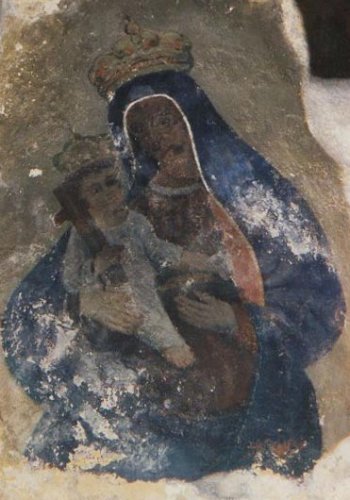
Near Brucoli, Sicily, in the gulf of Catania, attributed to Saint Agatone, 3rd century fresco.
|
This is probably one of the oldest depictions of the Mother of Christ in the world. Legend recounts that in the third century A.D., when the Roman emperors were still persecuting Christians, some dead martyrs appeared in a dream to Saint Agatone, the first bishop of nearby Lipari. They recommended a group of prehistoric caves as a safe shelter. It seems that other Christians had already secretly lived and worshiped in this remote place. The first Greeks who colonized and settled Sicily in the 9th century B.C.E. had turned the caves into burial places, hence their name: Caves of the Greeks. But the Christians claimed the caves for the living and for their God by adorning the walls with frescos. It is said that Saint Agatone himself went to live there, painted this Madonna and named her Maria Sanctissima Mater Adonai, or simply Adonai, that is: Most Holy Mary Mother of God, or simply God. Actually adonai is the Hebrew word most often used for God, but it literally translates as Lord. |
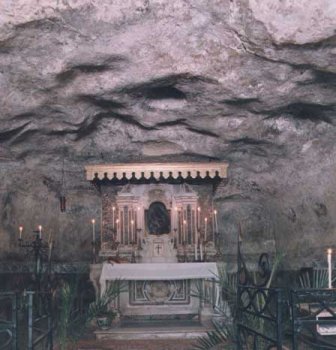 The cave with the round sky light in the ceiling |
Agatone was a well respected, saintly man who had converted Alexander, a tyrant of the nearby city Lentini. At the refuge of Mater Adonai, the saint tamed and instructed this man, gave him a new name, Neofito, and ordained him a priest. Later the converted tyrant was to become the first bishop of Lentini.
| In spite of Saint Agatone's standing, calling Mary 'Mother
of God' or simply 'God', 'Lord', must have raised a few eyebrows in
the Christian world. Strictly speaking, if Agatone wanted to call
her Mother of God, as Christians assume nowadays, then he should have
called her Mater Adonaii. But it seems he didn't bother with such
details as an extra i or the difference between Mother God and Mother
of God. He wasn't the only one for whom the distinction between Mary
and God had apparently blurred and the two had become one. It was
precisely this union of the heavenly Mother and Father in the hearts
of the faithful masses, that triggered such a clash at the council
of Ephesus in 431.By a thin margin did the council concede that the
full title 'Mother of God' was to be permissible. Simply calling Mary
God however, was surely out of the question - except in Sicily! A trace of this debate in the area is still found in an ancient inscription in the Cathedral of Lentini, whose first bishop, as mentioned above, was converted and trained under the gaze of Mater Adonai, Mother God. The inscription proudly declares: "Even before the council of Ephesus declared Mary Theotokos ('Mother of God' in Greek) the holy Church of Lentini worshipped her as such". |
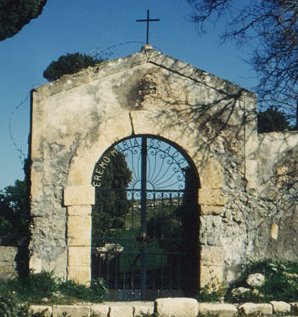 The entrance to the sanctuary bearing the words: Hermitage Maria SS (i.e. Santissima) Adonai |
According to the sanctuary's website there is no other place in this region of Greco-Roman culture where the divine is addressed by a Hebrew word. It is a singular tradition going back to the very beginnings of the Christian era.
Once the Roman emperor Constantine ended the persecution of Christians,
their refuge in the caves of the Greeks gradually seems to have been forgotten.
Any information about it suddenly ceases around the 4th century. Only
a vague memory of a cave with Saint Agatone's image of the Virgin Mary
survived. It was regarded as a legend until the Madonna Adonai was accidentally
rediscovered in the 16th century.
One day a shepherd was looking for his cow and found that it had fallen
into a deep hole in the ground. Following his animal down, he discovered
that the hole was the sky light of a cave, a typical Greek architectural
feature. In the cave he beheld the image of which people had talked for
centuries: the mysterious Black Madonna Adonai, the fresco of Saint Agatone!
The discovery was considered almost miraculous and the place began to
attract many pilgrims. Among them was a group of Spanish cavalry men.
(The Spaniards were occupying Sicily at the time.) They were so enchanted
by the beauty of the place and the sweet look of this ancient mother and
child, that they decided to renounce their worldly lives of privilege
and military power. The horsemen became hermits. In 1600 A.D. their community
built a monastery that drew many monks.
The place is still called Hermitage of Adonai, though the last hermit
who lived there passed away in 1950. Now it's a retreat center that welcomes
lay people into the old monks cells.(*1)
|
Directions: From the industrial town of Augusta in the province of Syracuse, take highway 114 North. Following signs to Brucoli will lead you off Hwy 114 on a short, windy road. Brucoli is a small tourist resort on the Ionian Sea. Up until a few years ago it was a fishing village in the gulf of Catania, which is dominated by the mighty Etna, the tallest active volcano in Europe. Just before you get to Brucoli there is a small sign pointing the way to "Madonna di Adonai." |
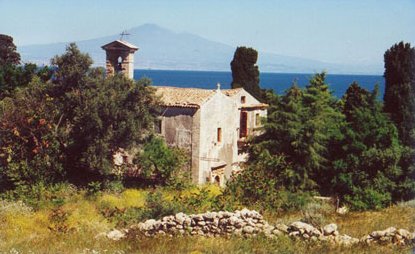 The sanctuary with Mt. Etna in the distance. The cave of Adonai was expanded into a small church. |