Caltabellotta:
Most Holy Mary of Miracles or of Succor
(Maria Santissima dei Miracoli o del Soccorso)
Patron of Caltabellotta
In the church of San Agostino. Caltabellotta lays
NW of Agrigento, Sicily on a breath taking mountain top.
photos: Ella Rozett
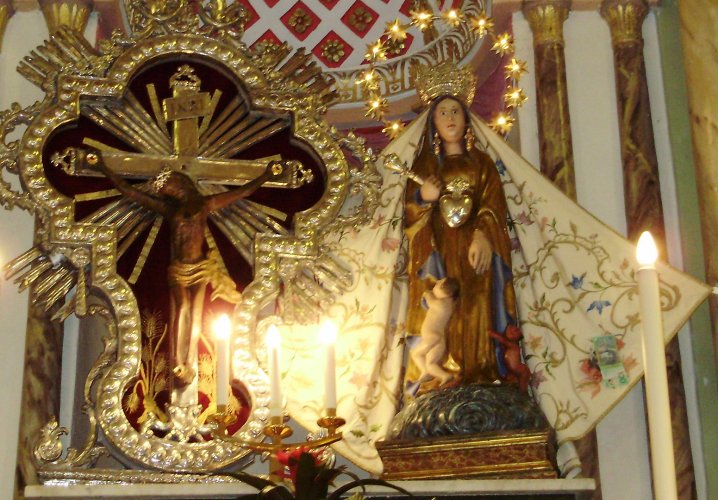
This is a story about Jesus and Mary and about an attempt
at equality. It started with the crucified black Jesus in the photo above.
He used to hang in the beautiful 11th century Chiesa Madre (Mother church),
had come from Byzantine lands and was considered miraculous. That reputation
has long been transferred to his Mother, but a painting still marks the
place where the crucifix originally hung with an inscription that promises
to remember in perpetuity this “most holy crucifix commonly called
miraculous”. (Notice the wheat offerings on its backing, so typical
for Sicily with its Demeter cult.*1) Now the crucifix
resides next to the Madonna of Miracles in San Agostino, though I don’t
know if it’s the original or a copy of it.
It is extremely rare to see Mary and Jesus represented as equal in size
and position next to each other above the altar. Usually one of them gets
to be center stage (often Mary) and the other is relegated to a side chapel,
or you may find a big statue of Mary enthroned above the altar while Jesus
hangs on a little crucifix on it.
I wish male and female, Jesus and Mary, were always together as equals like they are here. That’s why I am including Caltabellotta in this index of Black Madonnas even though the Madonna of Miracles looks rather white these days and Giuseppe Pipia, a true son of Caltabellotta, informed me that the locals do not regard her as Black. Visit his site for beautiful videos of Caltabellotta's religious festivals.
The present white Madonna may have replaced an older Black Madonna which
disappeared. Or it may be that some people think that every miraculous Madonna must be Black or dark at least. She is listed among Black Madonnas on the Italian Wikipedia page on Madonne Nere and on the University of Dayton Ohio's Marypage. There she is called brown and the crucifix black. It may be that over the centuries she absorbed the power and reputation
of her son.
How could this happen? It seems that the people were more interested in
a miraculous Black Madonna than in a miraculous black Jesus. To this day
you find little about him on the Italian websites dedicated to the Madonna
of Caltabellotta. So, perhaps with help from Heaven above, Mary’s
devotees in Caltabellotta created a story that allowed for a Madonna to
be set beside her black son.
It began in the 15th century when the county of Caltabellotta passed from the Peralta family to the Counts of Luna and a group of Augustinian monks wanted to settle in the city. The Lunas commissioned Master Francesco Laurana to sculpt a beautiful marble statue of the Virgin of Succor for the new monastery and church San Agostino. Though the original image was made of marble, in 1546 a wooden copy of it became venerated. How did this happen? Well, somehow Heaven had a hand in it, but there are four widely different explanations of what transpired.
1. It is said that a local craftsman who had a sick daughter, turned to the Virgin of Help and received the miracle of healing for his daughter. In thanksgiving he carved a small statue of the Madonna out of a fig tree stump and gave it to the Augustinian Fathers. Given the small size, the statue was carried in procession to the homes of the sick requiring her help. Once a healing took place, she would be returned to church adorned with gifts. Hence she became known as the Madonna of the Sick.
2. Another story reads: ... under the cliff Gogala, there was a beautiful fig tree, the owner, due to a special aspiration and some mysterious movements of the trunk, decided to make it into a statue of the Virgin. A few days later, the work was done and painted. He put it in the sun to dry and then went to attend to his fields. At noon a storm broke out and the farmer, remembering his work, rushed home to shelter it from rain. With amazement he saw that the statue was safe and dry with the colors perfectly preserved, even though no one had touched it.
3. Another version claims: ... one day a Father Paolo (Pallu, in Sicilian dialect), one of the Augustinian monks, (who died with a reputation of sanctity December 30, 1847), found in the rock garden under the cliff Gogala a piece of fig wood that drew his attention. He thought it might be useful for baring the door of the church and so he picked it up and put it to that use. When he went to open the church the next morning he saw that the piece of fig wood was gone.He asked the other monks if they had seen or taken it, but no one had.
Some time later he went to perform his ministry at the Mother Church, and with great astonishment, saw that the block of wood was near the crucifix (the miraculous crucifix of the black Jesus that now resides above the altar in the church of St. Augustine). Dismayed, he asked who brought that piece of wood to the Mother Church, but no one knew anything about it. So he took the thing back to his church and that evening used it again to bar the church door. By the next morning it was gone again. Now he accused his fellow monks of playing a bad tasteless joke on him. But seeing that they were quite bewildered by his accusations, he wondered what was going on. So he checked back at the Mother Church and saw, with astonishment, that the piece of wood was again lying near the crucifix. He took the piece of wood back to St. Augustine Church, placed it as before, and stood watch. When Night came, suddenly, he saw that the piece of wood took off from where it was placed, and moved on the road to the Mother Church. Arriving there it went as before to the crucifix. It was the Mother going to see her Son! Presumably she was hidden in the wood already and just had to be released by a sculptor, which was promptly accomplished. |
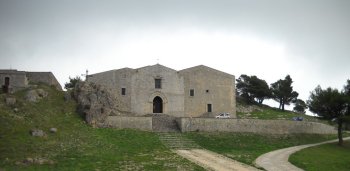 11th century Chiesa Madre, Mother Church; photo: Paul Fornaby |
|
4. Another story related to the devotion of Father Pallu recounts how this holy man had a special devotion to the Virgin. He spent his nights in the church in deep prayer and contemplation. One night he had a vision or apparition of the Mother of God. He saw her leaving the church through the main door. He followed her a little way, and watched her climb up the cliffs of Gogala. When she returned some time later he noticed that Our Lady's mantle had gotten dirty and he asked her: "Where have you been and why are your clothes dirty?" The Madonna answered that she often goes to the old Mother Church to be near her son crucified who resides there. This story forms the core of the Marian festival still celebrated today. Many miracles are recounted by popular tradition. On April 22nd
1601 the people of Caltabellotta voted to adopt the Madonna of Miracles
as their patron for having preserved them from the cholera. |
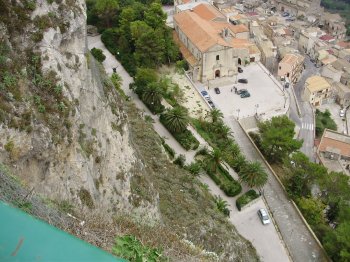 View from Chiesa Madre down the cliff Gogala to San Agostino |
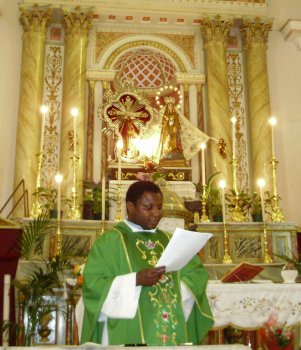
| When I visited in 2010 the parish priest Father Alfred
from Tanzania hadn’t heard any of these stories, but he was
very interested in my work on the Black Madonnas of Sicily. His explanation
for the title Madonna of Miracles was this: In 1956-7 there was a
terrible drought in the region and the parishioners were split over
the question whether they should pray for rain in the old fashioned
way, i.e. taking the Madonna on a procession and begging her for rain.
One lay woman decided to go ahead with the procession, even if some
priests and lay people were against it. Last minute she could convince
one priest to join her group but she led the prayers high up on a
mountain overlooking the town. While she prayed it started to rain.
It was on March 27th and since then people again process Mary (and
Jesus) up to that mountain top every year on the last weekend in March.
The event is organized by a women’s group and is called "the
Feast of the Most Holy Crucifix and of Most Holy Mary of Miracles".
As in Olot, Spain, so here too it is the custom to let children take their first steps towards the throne of the Blessed Virgin. As soon as they have the strength to walk, they are made to proceed a certain distance towards their Heavenly Mother. So where is the equality in this story? In the visual effect of Jesus and Mary on the altar, inspired by the intention of the Blessed Mother to be close to her Son. Most people, patriarchs and feminists alike, still can’t wrap their hearts around equality, but the Madonna of Caltabellotta encourages us to keep trying.(*2) |
 |
_______________________________________________________________________________
*1: For more information read about: “Mary,
the Earth, and Demeter” in the Custonaci entry in this index.
*2: Much information gathered from: www.Caltabellotta.com and www.Caltabellotta.net